The CheckMig form is mandatory for all international entries into Colombia, including land border crossings. Whether you are crossing by bus from Ecuador, driving from Venezuela, or walking across from Panama, you must complete the CheckMig form online before arriving at the border. This guide covers every major land crossing, the step-by-step process, and what to do if things go wrong.
Do You Need CheckMig for Land Border Crossings?
Yes. The CheckMig requirement applies to all international arrivals in Colombia, regardless of how you enter. The form was originally designed for air travelers, but Migración Colombia enforces it at every official land border crossing point as well.
This means if you are:
- Taking a bus from Quito or Guayaquil to Bogotá via the Ipiales border
- Driving from Venezuela through the Maicao crossing
- Walking from Panama through the Darién Gap region (Capurganá or Turbo)
- Entering from Brazil via Leticia in the Amazon
…you need a completed CheckMig form with a valid QR code before you reach the immigration counter.
Key rule: Fill out CheckMig 72 hours to 1 hour before you arrive at the Colombian border. Not before you leave your origin city, but before you physically arrive at the Colombian immigration checkpoint.
How to Fill Out CheckMig for a Land Crossing
The process is nearly identical to filling it out for a flight, but there are a few differences for land travelers:
Step 1: Go to the official CheckMig website: migracioncolombia.gov.co
Step 2: Select “Entry” (Ingreso) as your direction of travel.
Step 3: When asked for your flight information, select the land/sea entry option if available. If the form only asks for a flight number, enter your bus company name or route (e.g., “Pullman Bus” or “Terrestre”).
Step 4: Fill in your personal details exactly as they appear on your passport.
Step 5: Enter your Colombian accommodation address. If you are in transit, use the address of your first overnight stop.
Step 6: Complete the health declaration section.
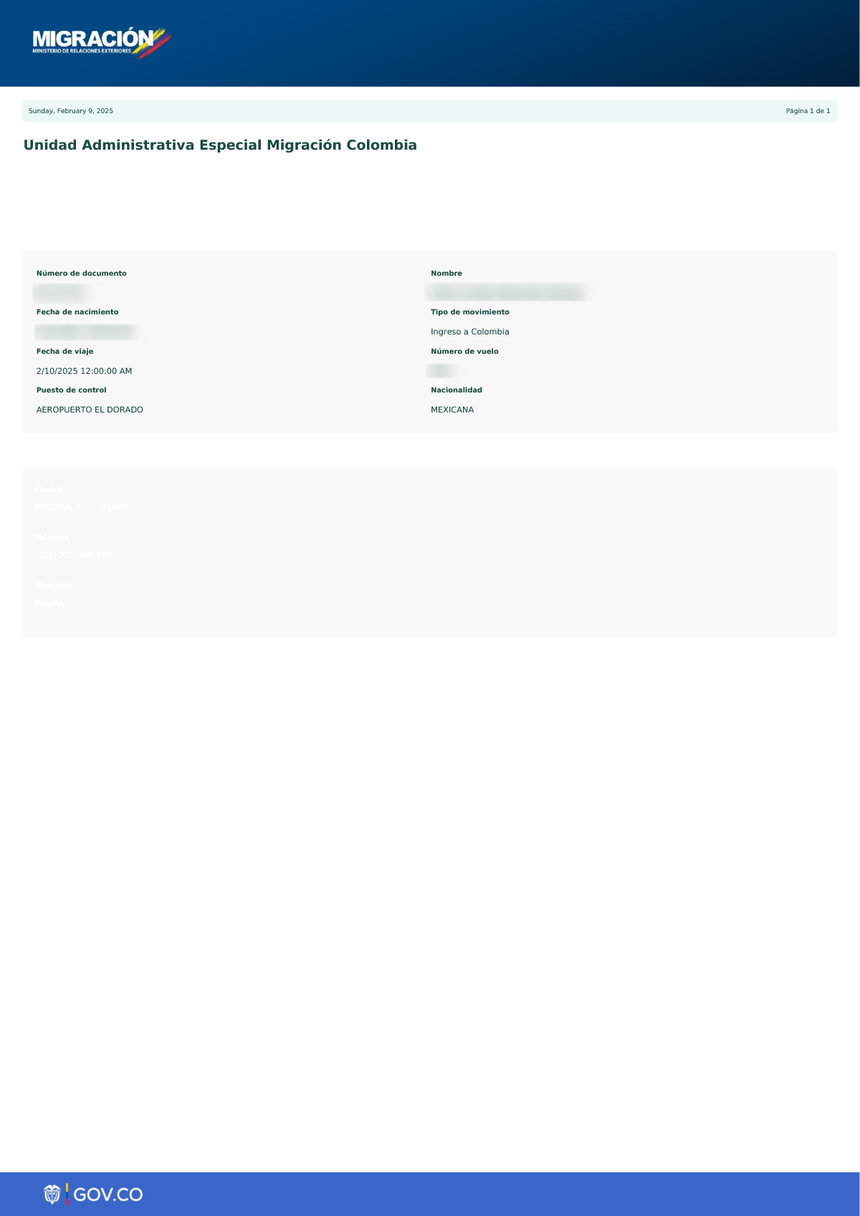
Step 7: Submit and download the PDF confirmation with QR code. Save it on your phone and optionally print a copy.
Pitfall for land travelers: The CheckMig system was originally built for air travel. Some fields (like “flight number”) may not perfectly fit a land crossing. Use the bus company name or write “Terrestre” (land transport). Immigration officers at border crossings are used to this and will not reject your form.
Colombia’s Main Land Border Crossings
| Border Country | Main Crossing Point | Nearest Colombian City | Status |
|---|---|---|---|
| Ecuador | Ipiales / Rumichaca | Ipiales, Nariño | Open, busiest land crossing |
| Venezuela | Maicao / Paraguachón | Maicao, La Guajira | Open, subject to periodic closures |
| Panama | Capurganá / Turbo | Turbo, Chocó | Open, limited infrastructure |
| Brazil | Leticia / Tabatinga | Leticia, Amazonas | Open, river crossing common |
| Peru | Leticia / Santa Rosa | Leticia, Amazonas | Open, via Amazon river |
Note: The Colombia-Panama border has no road connection. Crossings between these two countries involve boats or small aircraft from Capurganá or Turbo on the Colombian side. The Darién Gap itself is not a formal crossing point and is extremely dangerous.
The Land Border Crossing Process Step by Step
Here is what to expect when crossing into Colombia by land:
1. Arrive at the border zone
Most land crossings have a clear border area with signs for immigration on both sides. At Rumichaca (Ecuador-Colombia), there is a bridge connecting the two countries. At Maicao, there is an immigration building near the road.
2. Exit the departing country
Before entering Colombia, you must first get an exit stamp from the country you are leaving. This is usually at a separate counter or building on the other side of the border.
3. Enter the Colombian immigration office (Migración Colombia)
Walk to the Colombian side and find the Migración Colombia office. It is usually a small building near the border crossing point.
4. Present your documents
Hand over:
– Your passport (open to the photo page)
– Your CheckMig PDF (on your phone screen or printed)
5. QR code scan and verification
The officer will scan the QR code from your CheckMig confirmation. They will verify that your passport details match the form.
6. Answer basic questions
The officer may ask:
– How long you plan to stay in Colombia
– Where you are going
– Purpose of your visit
7. Get your entry stamp
The officer stamps your passport with the entry date and number of allowed days (usually 90 days for tourists).
8. Proceed into Colombia
You are now legally in Colombia. Continue by bus, taxi, or on foot to your destination.
The entire process at the immigration counter typically takes 15 to 30 minutes, though it can take longer during busy periods (holidays, weekends, early mornings).
Crossing from Ecuador by Land
The Rumichaca crossing near Ipiales is the most popular land border between Colombia and Ecuador. Thousands of travelers cross here every day.
How to get there: Buses from Quito to Ipiales run regularly (approximately 6-8 hours). Major operators include Pullman San Cristóbal, Transipiales, and CIFA. You can also take a bus to Tulcán (Ecuador’s border town) and walk across the bridge.
Process at Rumichaca:
1. Get your Ecuador exit stamp at the Ecuadorian immigration office
2. Walk across the bridge to the Colombian side
3. Enter the Migración Colombia building
4. Present passport and CheckMig QR code
5. Get your Colombian entry stamp
Tips:
– The crossing is open 24 hours, but immigration offices have set hours (typically 6 AM to 10 PM)
– Weekends and Colombian holidays can mean longer queues
– Money changers operate at the border, but rates are better in Ipiales town
– The Ipiales sanctuary of Las Lajas is worth a visit if you have time
Crossing from Venezuela by Land
The Maicao / Paraguachón crossing in La Guajira department is the main land border between Colombia and Venezuela.
Current situation: The Venezuela-Colombia border has experienced periodic closures and restrictions. As of 2026, the border is open for regular crossings, but check current status before traveling.
Process:
1. Get your Venezuelan exit stamp (if leaving Venezuela)
2. Cross to the Colombian side
3. Present at Migración Colombia with your passport and CheckMig
4. Get your entry stamp
Tips:
– The crossing can be chaotic, especially during Venezuelan migration surges
– Arrive early in the morning to avoid long waits
– Maicao is about 2 hours from Maracaibo (Venezuela) and 3 hours from Riohacha (Colombia)
– Have cash in Colombian pesos ready for transport from the border
Crossing from Panama by Land
There is no road connecting Panama and Colombia. The Darién Gap is a dense jungle region that separates the two countries, and there is no formal road crossing.
Official options:
– By boat: From Capurganá or Turbo (Colombia) to Puerto Obaldía or other Panamanian ports
– By air: Small flights between Capurganía and Panama City
– By sailboat: Some travelers arrange passage through the San Blas Islands
If you enter Colombia by boat from Panama:
1. Arrive at a Colombian port with immigration services (Capurganá, Turbo, or Necoclí)
2. Present your passport and CheckMig at the Migración Colombia office
3. Get your entry stamp
Warning: Attempting to cross the Darién Gap on foot is extremely dangerous. It involves dense jungle, rivers, armed groups, and venomous wildlife. This is not a recommended or legal crossing route.
Crossing from Brazil and Peru by Land
Leticia, Colombia sits at the triple border of Colombia, Brazil, and Peru. This is the main land/river crossing point for these three countries.
From Brazil: Cross from Tabatinga (Brazil) to Leticia (Colombia). The two cities are essentially one urban area separated by an imaginary border line. You can walk between them.
From Peru: Take a river boat from Iquitos (Peru) to Santa Rosa (Peru), then a short boat ride to Leticia (Colombia). Alternatively, travel from Pucallpa to Iquitos to Santa Rosa.
Process at Leticia:
1. Get your exit stamp from Brazil or Peru at the respective immigration office
2. Enter the Migración Colombia office in Leticia
3. Present your passport and CheckMig
4. Get your Colombian entry stamp
Tips:
– Leticia is only accessible by air or river from the rest of Colombia
– Immigration offices in Leticia have specific hours; arrive during business hours
– The Amazon river crossing from Santa Rosa to Leticia takes about 10 minutes by boat
What Happens If You Cross Without CheckMig
If you arrive at a Colombian land border without a completed CheckMig form, here is what typically happens:
- You will be directed to fill it out on the spot. Some border crossings have tablets or kiosks for this purpose.
- You need internet access. The form is online. If there is no Wi-Fi at the border and you do not have mobile data, you will need to find a connection.
- You will wait longer. Completing the form at the border adds 15 to 30 minutes to your crossing.
- Immigration may question you more closely. Officers may ask why you did not complete it in advance.
While Colombian immigration does not typically deny entry solely for a missing CheckMig, the delays are unnecessary. At remote border crossings (like Leticia or Capurganá), there may not be facilities to fill out the form on the spot, making advance completion essential.
Common Mistakes to Avoid
Filling out CheckMig too early.
The form must be completed no more than 72 hours before arrival. If you fill it out a week in advance, it will not be valid.
Filling out CheckMig too late.
Complete it at least 1 hour before reaching the border. Do not wait until you are standing in line.
Using flight details for a land crossing.
If the form asks for a flight number and you are traveling by land, enter the bus company name or “Terrestre.” Do not leave it blank.
Not having internet access at the border.
Some remote crossings have no Wi-Fi or mobile signal. Download your CheckMig PDF before losing connectivity.
Forgetting that CheckMig is also needed for departure.
You need a separate CheckMig form when leaving Colombia by land as well. Fill it out before your departure crossing.
Assuming the border is open 24/7.
While some crossings (like Rumichaca) are technically open around the clock, immigration offices have operating hours. Arrive during business hours to ensure you get your stamp.
Frequently Asked Questions
Do I need CheckMig if I am just transiting through Colombia by land?
Yes. Even if you are only passing through Colombia to reach another country, you must complete a CheckMig form when entering the country. There is no transit exemption.
Can I fill out CheckMig at the border crossing?
Technically yes, if you have internet access and the border has facilities. However, this is strongly discouraged. Fill it out before you travel to avoid delays and complications.
What do I enter for the flight number if I am traveling by bus?
Enter the bus company name (e.g., “Pullman,” “Transipiales,” “CIFA”) or simply write “Terrestre” (meaning land transport). Immigration officers at land crossings are accustomed to this.
Is CheckMig required for the Ecuador-Colombia border at Rumichaca?
Yes. The Rumichaca crossing near Ipiales is an official border point, and CheckMig is enforced there just as it is at airports.
Can I walk across the Colombia-Panama border?
There is no road between Colombia and Panama. The Darién Gap is a dangerous jungle region. Official crossings involve boats or flights between Capurganá/Turbo and Panama. Walking through the Darién Gap is not recommended and is extremely dangerous.
Do children need their own CheckMig form for land crossings?
Yes. Every traveler, including children and infants, needs their own individual CheckMig form. Parents or guardians can fill it out on behalf of minors.
What if the CheckMig website does not accept my bus information?
Try entering the bus company name, route, or simply “Terrestre.” If the system still rejects it, contact Migración Colombia directly or ask for assistance at the border. Officers are familiar with this issue.
Related Guides
- What Is CheckMig? Colombia’s Immigration Form Explained – Learn the basics of the CheckMig form
- How to Fill Out CheckMig: Step-by-Step Guide – Detailed form completion instructions
- CheckMig Arrival: What Happens at the Airport – The airport arrival process explained
- CheckMig Deadline: When to Fill It Out – Timing rules for the form
- CheckMig Not Working? How to Fix Common Issues – Troubleshooting tips